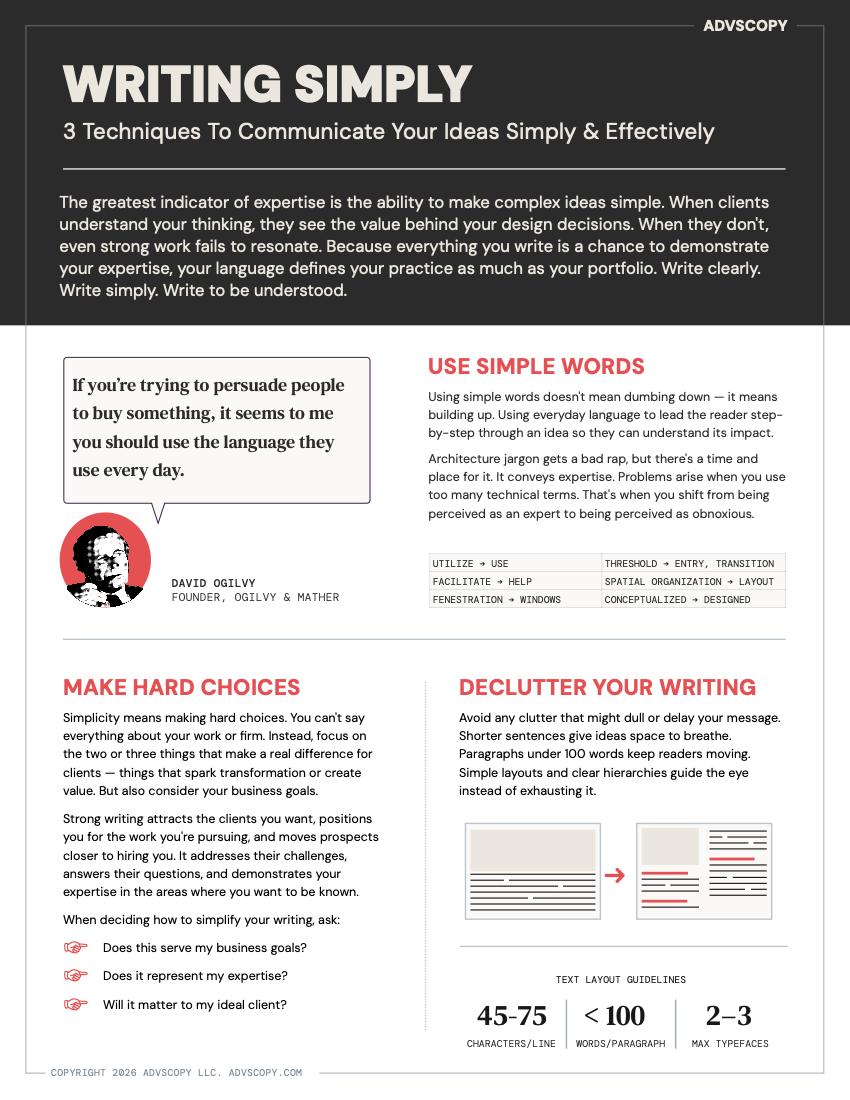
Write Simply: 3 Techniques to communicate your ideas clearly & effectively
The strategic utilization of accessible language produces a more profound communicative impact than the deployment of terminology that necessitates greater cognitive effort.
Wait, we can do better than that:
Using simple words and phrases that everybody can understand has a greater impact than using words that some people might struggle with.
Still note quite right...
Simple language is more powerful than complicated words.
There we go.
When I think about simple language, I often cite this quote from David Ogilvy:
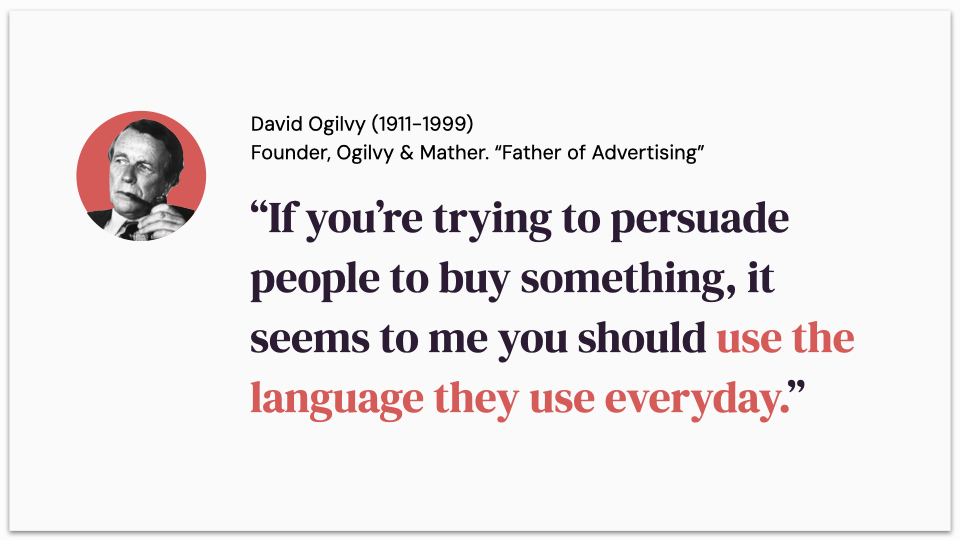
I know a lot of architects struggle with the idea of "selling" (that's a topic for another post), so let's just focus on the idea of language for now. All Ogilvy is saying is that, in business, we should strive to be understood by our prospective clients. For some reason a lot of architects struggle with that too.
This principle drove my entire career as a design journalist. When I was writing about architecture & design for publications like Smithsonian, The Guardian, and Wired, I worked with general interest audiences who didn't speak the language of design. My job was to make concepts like early modernism, victorian interior design, and the aesthetic theories driving Rem Koolhaas's skyscraper design accessible to the average reader. I did this by using clear, engaging language, by linking ideas to things they already understood, and only choosing the most essential points to convey my idea.
The stakes are even higher when architects write for clients. You’re not losing readers; you’re losing work.
Use Simple Words
It's become almost a cliché at this point, but I still see so many architects write in elaborate loops full of jargon that alienates anyone who is not an architect. Maybe you're imitating something from school. Maybe it's what you think clients expect. Maybe you think it shows authority of expertise.
Jargon is an easy target here. But there is a time and a place for "fenestration" instead of "window." Professional language can convey expertise. The problems start when you string too many of these words together. Or use them without context that the reader can understand. Then you move from being perceived as an expert to being perceived as obnoxious.
Because the surest sign of expertise isn't reciting complex ideas. It's making complex ideas easy to understand. This doesn’t mean dumbing things down. It means building things up. Give the reader a foundation of understanding. Link simple ideas to convey more complex ones.
Overly wrought, complicated language makes readers work harder to understand you. And when people work too hard, they stop reading. They stop caring.
Declutter Your Writing
Attention is a limited resource. Every dense wall of text, overly long paragraph, run-on sentence, extraneous extra clause and complicated word spends a bit of it. Eventually, there's none left for the part where you actually communicate your value.
Beyond simple language, simple sentences and paragraphs and structure are all equally important. They give your ideas space to breathe. Paragraphs under 100 words keep readers moving. Simple layouts guide the eye instead of exhausting it. The point is to avoid any clutter that might dull or delay your message.
A few quick layout guidelines
45-75 characters per line
less than 100 words per paragraph
2-3 typefaces max.
Design your text the way you'd design a building — with purpose, hierarchy, and flow.
Make Hard Choices
Above all, simplicity means making hard choices about what matters most. You can't say everything about your work or firm. Instead, choose the two or three things that will actually move your business forward — the capabilities that attract your ideal clients, the expertise that sets you apart, the value propositions that align with your strategic goals.
Every choice you make should serve these goals. Strong writing attracts the clients you want, positions you for the work you're pursuing, and moves prospects closer to hiring you. By simplifying your message around what truly matters, your positioning becomes sharper and your business strategy becomes clearer.When deciding how to simplify your writing, ask:
Does this serve my business goals?
Does it represent my expertise?
Will it matter to my ideal client?
Everything you write is a chance to reify your expertise. Every proposal, case study, web page, social media post—everything— should communicate some aspect of your value — and your values.
But clients need to understand you to see the value behind your design and trust your decisions. When they don't, even strong work fails to resonate. Write clearly. Write simply. Write to be understood. Your language—what you choose to say and how you say it—defines your practice just as much as your portfolio.